
SciFind.io: the Expert Network for Biotech Scientists
Think StackOverflow but for Biotech, SciFind was an expert network for scientists where they shared information beyond the publication and helped eachother troubleshoot experiments.
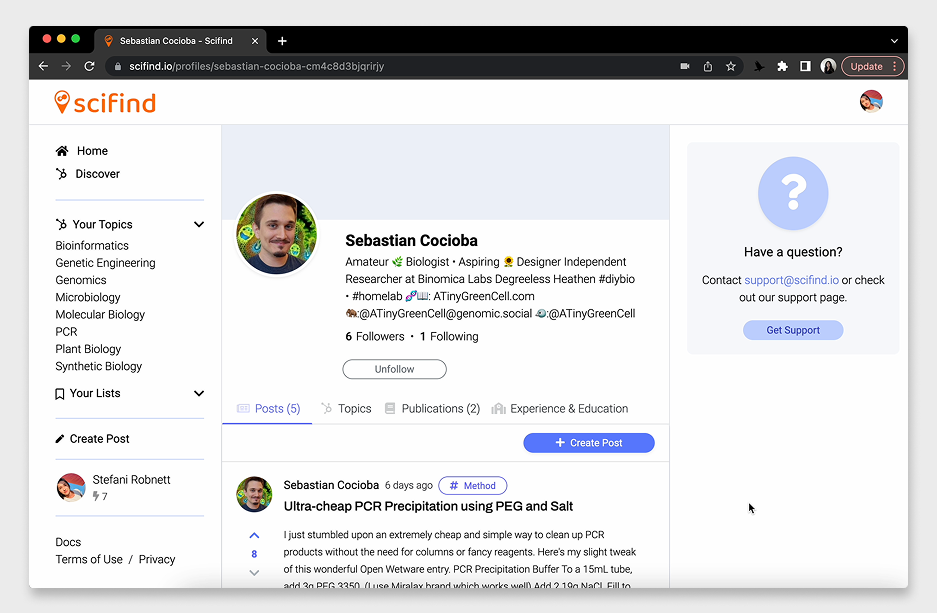
Plagued by monopolistic publishing industry with the highest margins out of all industries, early stage R&D researchers, especially in biotech experience major set backs that cause innovation and progress to move extremely slowly. Guy, who was a genomics scientist and the first employee at a genomics start up, had experienced the resulting frictions first hand. Me on the other hand, having come from a major tech company, was used to the vibrant online communities and forums that helped bring rapid advancements to digital technology.
Together, we cofounded SciFind in 2020 alongside Guy Rohkin with the overall goal of finding opportunities to improve collaboration infrastructure in biotech R&D. We brought on Georgy Savva as our CTO to help build a modern infrastructure, with semantic modeling and system architecture that could support our highly technical community.
The problem:
Biotech scientists waste an estimated 30% of their time trying to reproduce experiments from publications.
That wasted time translates to billions of USD wasted anuually in early-stage R&D spends. Biotech research is extremely expensive due to cost of materials and equipment and labor, and set backs in communication cause individual scientists working in isolation to reinvent the wheel when other scientists had surely encountered the same challenges. On a macro-level, biotech R&D has a reproducibility crisis, with over 40% of published scientific papers estimated to be irreproducible. While this phenomenon has been well documented, little has been done to improve the situation effectively.
Our goal was to build an updated research and communications infrastructure for biotech researchers so that they would waste less time trying to reproduce experiments.
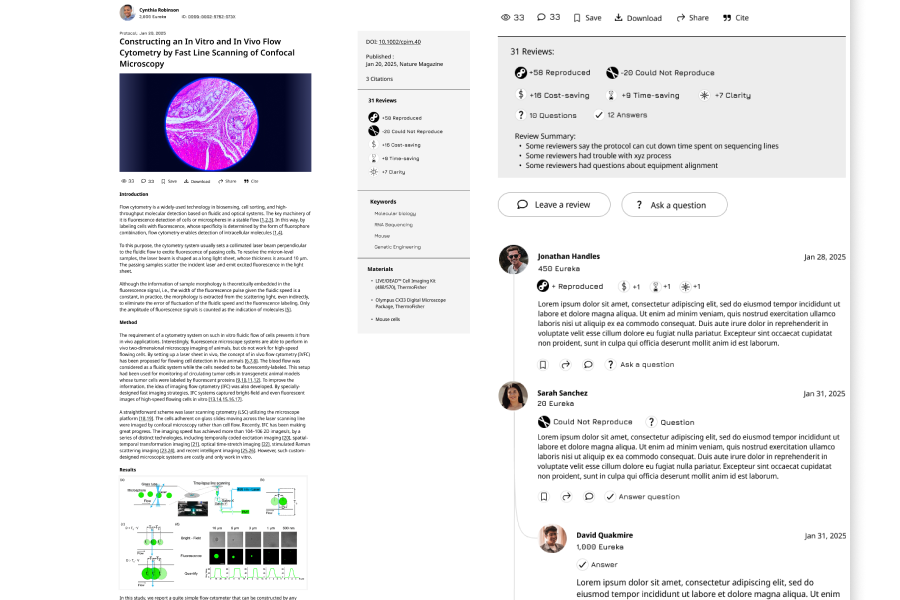
Our solution was to build a StackOverflow for Biotech
The platform would be open-access and free to use, a place where researchers could share information beyond the publication (such as in-depth research methods with rich-text, videos, and images), and get troubleshooting support from their community.
Contributors would receive reputation in a faster, more meaningful way than with citations. To do so, we designed custom badges like “time-saving, cost-saving, reproduced, or not reproduced - symbols that allowed researchers to make informed decisions on which methods to try to reproduce in their labs.
The result
As a result, SciFind became a thriving online platform with 10k monthly active users, all scientific researchers in biotech fields. At our peak we were receiving over 80 organic posts per month, all troubleshooting questions or rich scientific methods. Out of those posts, about 60 percent were troubleshooting questions. We made it a community priority to make sure no question went unanswered, and that all answers were posted within 48 hours.
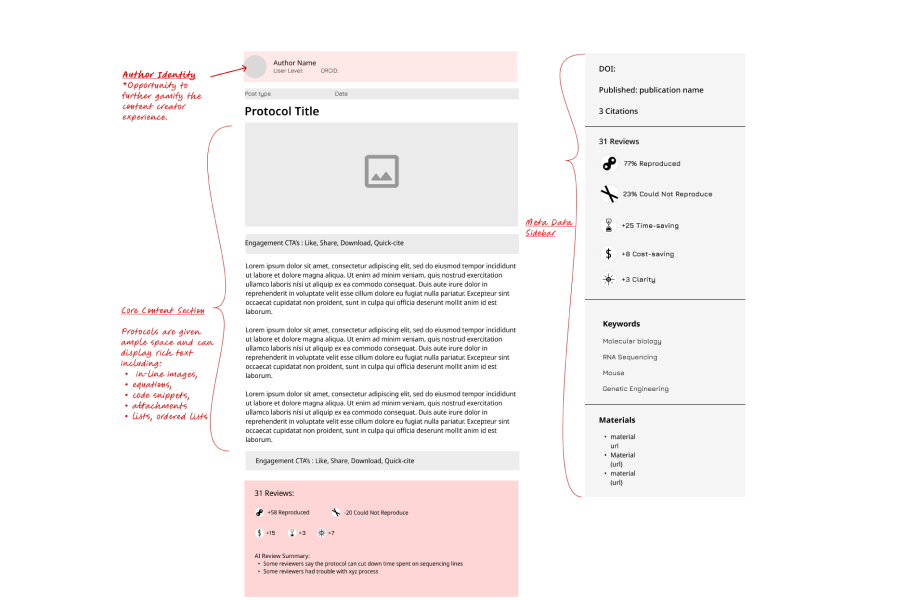
Ideation: content creation & information hierarchy
When you ask scientists why methods are so hard to reproduce from papers, often times you'll get a synical answer: scientists want to hide their methods, or even intentionally obfuscate their results, so that other scientists CAN'T reproduce their work and they keep their competitive edge. While this might be the case for some, we believed the problem had more to do with the medium of communication rather than scientists at large acting on their 0-sum views at the expense of the broader community.
The typical scientific method is embedded in the Materials and Methods section of each scientific paper. For each paper, you might find 10-30 scientific methods. Each method details a portion or an experiment that was run in order to develop the arguments for the paper, most with a different contributing author. Due to publishing formatting constraints, these methods are typically abbreviated; a multi-page method with images and equations will be consolidated to a paragraph. Because there might be 10+ authors on the paper, it's really hard to figure out which method comes from which author.
This lack of specificity for mapping individual contributions to their methods makes citations more disorienting than useful if you're just looking for methods to reproduce.
It also makes troubleshooting extremely difficult: how do you know which author to reach out to? (My cofounder used to go into the author's publication history and try to build a methodological track record in order to figure out which method they were responsible for - an arduous task that holds back collaboration.) A paper with a high number of citations is highly attractive, but can at times red herring. Papers with theoretical arguments get cited up to 10x more than papers with real applicable utility for actually running experiments, and if a method in a paper is irreproducible, it is highly unlikely the authors will be challenged.
Despite its flaws, the success and reputation of scientists are dependent almost entirely on the number of citations your papers have. Academic research is highly competitive, and research funding is largely based on the scientist's reputation - aka how many paper's they've published in the past, which journals they've published in, their impact or number of citations. Young researchers who see how quickly digital technology moves and are extremely frustrated with the gate-kept nature of academic research.
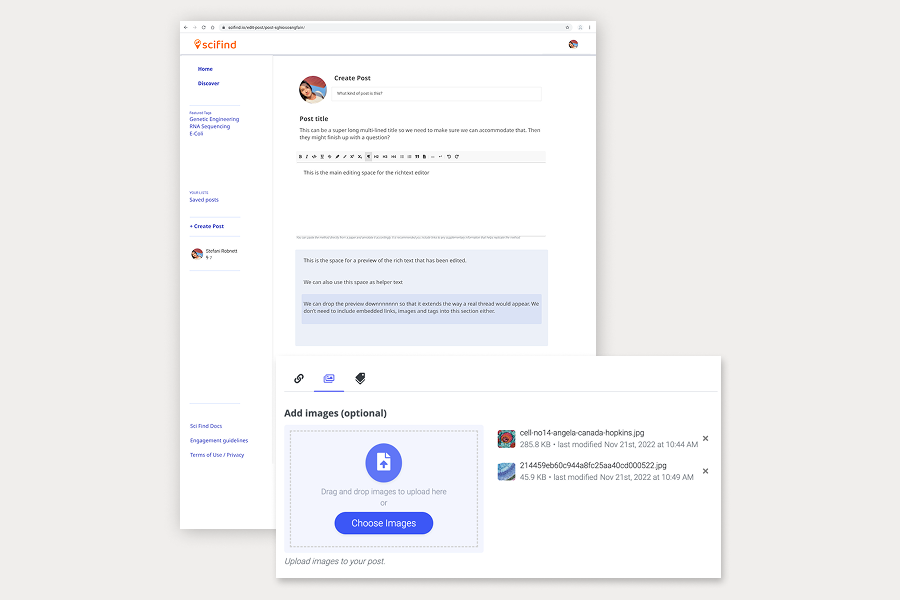
Our final solution needed to enable content creation as simple as “ask a question,” or as complex as “post a method.” We also wanted to make content creation a rich experience. We pulled inspiration from Reddit because it allowed for forum-like engagement and gave posters maximum autonomy in strucuturing their posts, allowed for rich text editing, images and media previews.
We also needed to rethink reputation building so that it could translate to something more meaningful and useful for the purposes of reproducing research methods. A digital forum like reddit or StackOverflow gave us a unique opportunity to bring value to our community for other reasons as well. Citations can take years to accumulate because they are dependent on the accumulation of publications, subject to long, multi-year publication timelines. Content engagement on online forums on the other hand are instantaneous.
Solution details: redesigning scientific methods for the digital age
Our final solution needed to enable content creation as simple as “ask a question,” or as complex as “post a method.” We knew we needed to start by redesigning scientific methods so that they were easier for scientists to reproduce. We started by unshackling the formatting constraints scientists typically run into when publishing methods, which cause them to cut a lot of useful information, and instead gave our content creators rich editorial control, using Reddit as an inspiration. Methods on SciFind could include images, links, videos, & rich text, and tags, all of which made methods much more engaging and easier to follow/ apply.
Strategy: overcoming the chicken-or-the-egg
Other platforms and forums would use covert methods to overcome the chicken-or-the-egg, often by creating fake user profiles and posting content. We couldn't just fake the content we and post from fake user profiles - our content had to actually be useful for biotech experts. If we didn't post useful content, they would see right through it and our brand name would suffer.
Research & User Profiling
To get to a StackOverflow for biotech, we had built and tested 2 other platforms for biotech researchers operating on different pain-point theses. By the time we got to our second pivot, we had spoken to over 500 PhD scientists between my cofounder and I, and this allowed us to develop rich user profiles and zero-in on our troubleshooting & reputation-building platform thesis. By going back to the basics and really understanding the populations we were trying to serve, we were able to build strategies for content creation & engagement loops.
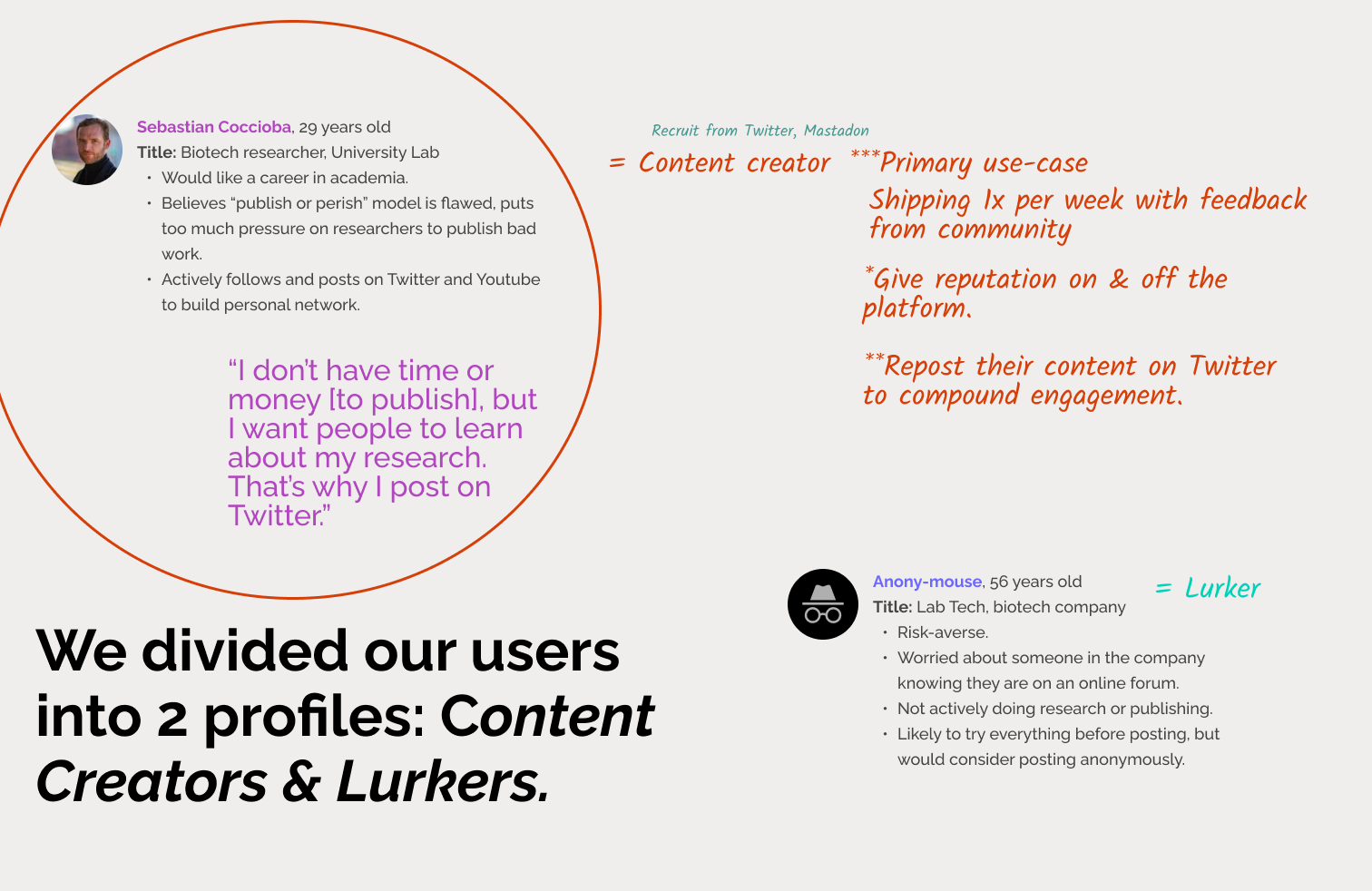
We identified 2 distinct user-profiles:
1. Askers/Lurkers. These were people who mostly consume research content, and might ask a troubleshooting question but only when they were desperate for support, and often only wanted to do so anonymously. In other words, these were stereo-typical biotech scientists; introverted, head-down, risk-averse.
*We found that these users could be recruited proactively. Anytime they would post a troubleshooting question on some old-school forum (like this CRISPR forum) we would dm them and tell them to repost the question in our forum. We found a 80% success rate with this method, as long as we dm'd them within the same 24hs as the initial post.
2. Scientific influencers. These were our Content Creators, users who we could count on to post reproducible methods and engage with the rest of community by answering questions and commenting on other user's posts.
*The major insight here was that both of these user types had similar behaviors on other platforms. Our scientific influencers were already posting videos and methods on facebook groups, twitter and mastadon. We just had to find a way to recruit them onto our platform. To do this we would develop a reputation building system, one that was faster, and in some ways, meaningful than publishing papers.
Scientific influencers were givent the title "Communtity Leaders" and were invited into weekly community meetings, where we could demo and test new features, content creators were invited to create content for the community. This gave us a pathway for rapid feedback and product iteration. Once all our core platform infrastructure was developed and could support both types of posts (scientific methods and troubleshooting questions & answers), we shifted our 80% of our product development efforts to building for our Content Creators.
“I spent 8 months trying to troubleshoot a method from gold-standard neuroscience paper, only to find out it was impossible to reproduce.”
- Community member & neuroscientist, Stanford University

Solution details: reputation games that improved scientific reproducibility
On SciFind, contributors would receive reputation in a faster, more meaningful way than with citations. To do so, we designed custom badges like “time-saving, cost-saving, reproduced, or not reproduced - symbols that allowed researchers to make informed decisions on which methods to try to reproduce in their labs. Each badge assigned had a point value which we called, "Eureka points." Much like Reddit or StackOverflow, community members would build their Eureka points and badges, which were displayed in the member's profile.
If for example you posted a method, you would recieve 10 Eureka points. If someone was able to reproduce the method, they could assign the post a "Reproduced" badge with a comment for other community members to reference. Reproduced badges translated to +2 Eureka points. If someone was unable to reproduce your method, they could add the badge, "Not Reproduced," translating to a -1 Eureka point.
Our Community leaders, having already had the experience of posting methods on Twitter, were encouraged to repost their Methods from SciFind onto Twitter to bring in more views to SciFind. In doing so, we were able to leverage their audience to build our platform, and their reputation in the process. This is how we were able to gain 10k monthly active users within just a few months of piloting our reputation system.
Out of all of the things we learned while working on SciFind, reputation building pain-points for scientists was by far the most fruitful insight in terms of building traction.
.svg)